
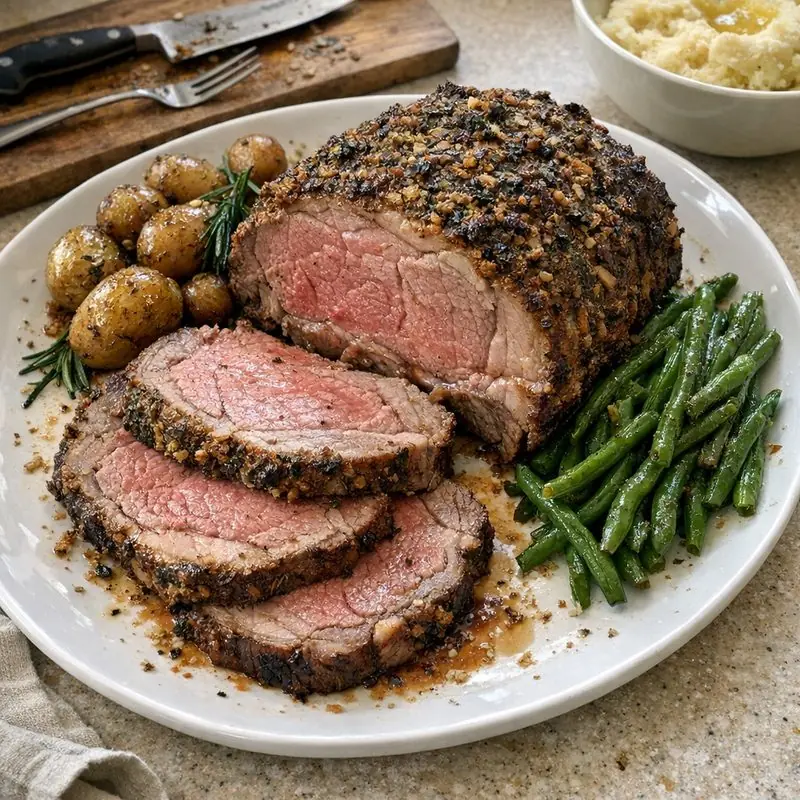
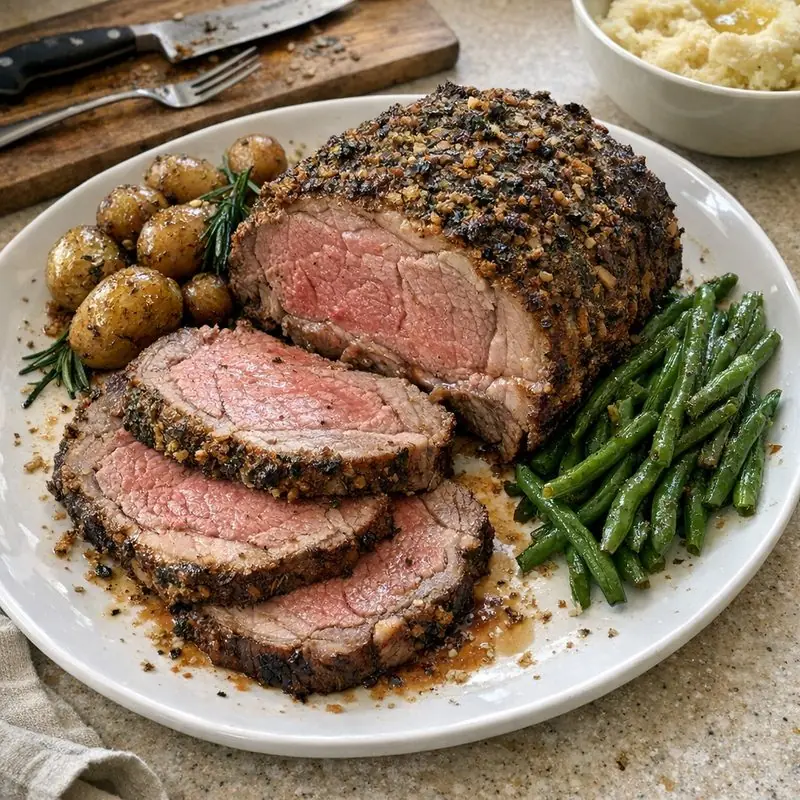
This holiday prime rib roast is the centerpiece your table deserves. It takes about 3 to 4 hours from start to finish (mostly hands-off oven time), and it suits any confident home cook who wants to serve something genuinely spectacular. The technique is straightforward — a bold herb crust, a high-heat sear, and a slow roast — and the result is a roast that’s deeply browned on the outside and rosy pink all the way through.
- 1 bone-in prime rib roast, 4–5 bones (about 8–10 lbs), also called a standing rib roast
- 3 tablespoons kosher salt
- 2 tablespoons freshly cracked black pepper
- 8 cloves garlic, minced or pressed
- 3 tablespoons fresh rosemary, finely chopped
- 2 tablespoons fresh thyme, finely chopped
- 2 tablespoons Dijon mustard
- 2 tablespoons olive oil
- Horseradish sauce, for serving
- 1 cup beef broth (for au jus)
- 1/2 cup red wine (for au jus)
- Pat the prime rib completely dry with paper towels — surface moisture is the enemy of a good crust. Season generously all over with the kosher salt.
- Place the salted roast uncovered on a rack set over a rimmed baking sheet and refrigerate for at least 1 hour, or ideally overnight (up to 24 hours). This dry-brine seasons the meat deeply and dries the exterior for maximum browning.
- Remove the roast from the refrigerator 2 hours before cooking to allow it to approach room temperature, which ensures more even cooking throughout.
- Make the herb paste: In a small bowl, combine the minced garlic, chopped rosemary, chopped thyme, Dijon mustard, olive oil, and cracked black pepper. Stir until a thick, cohesive paste forms. It should taste boldly seasoned.
- Using your hands or a spatula, press the herb paste all over the top and sides of the roast in an even layer. The bones on the bottom do not need coating.
- Preheat the oven to 450°F (230°C). Place the roast bone-side down in a roasting pan — the rib bones act as a natural rack, no additional rack needed.
- Roast at 450°F for 20 minutes to build a deeply browned, crackling mahogany crust. Do not open the oven during this stage.
- Without opening the oven door, reduce the temperature to 325°F (165°C). Continue roasting until an instant-read thermometer inserted into the thickest part of the meat away from the bone reads 120°F (49°C) for rare, 130°F (54°C) for medium-rare, or 140°F (60°C) for medium. Plan on roughly 15 minutes per pound at the lower temperature as a rough guide, but rely on the thermometer, not the clock.
- Transfer the roast to a cutting board and tent loosely with foil. Rest for 20–30 minutes — carryover cooking will raise the internal temperature another 5–10°F and the juices will redistribute throughout the meat.
- While the roast rests, make a quick au jus: set the roasting pan over two burners on medium heat. Pour off all but about 2 tablespoons of the fat. Add the beef broth and red wine, scraping up all the browned bits from the bottom of the pan. Simmer for 5 minutes, then season with salt and pepper and strain into a small pitcher.
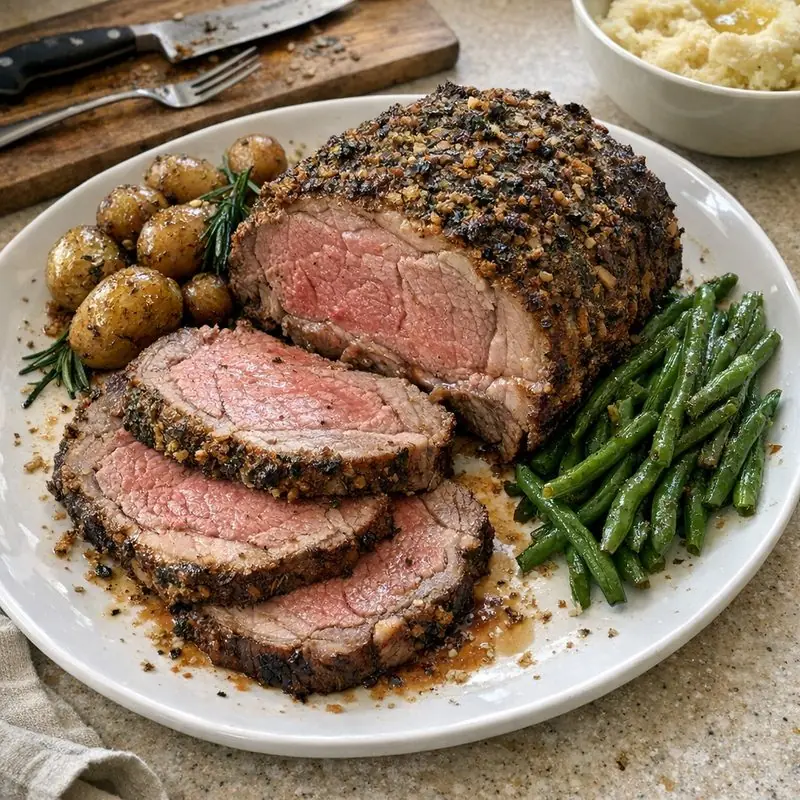
- To carve, stand the roast upright and slice along the bones to remove them as a slab. Then slice the roast across the grain into ¾-inch to 1-inch thick portions. Serve with the au jus and horseradish sauce.
What makes this version work is the two-stage cooking method. You blast the roast at high heat first to develop a mahogany crust, then drop the temperature and let the beef slowly come to temperature. That contrast is everything. The outside stays crispy and intensely savory, crusted with garlic, rosemary, thyme, and cracked black pepper. The inside is buttery and tender, with that signature faint pink blush that makes a room go quiet when you set it on the table. The smell alone — roasted garlic and herbs mingling with rendered beef fat — is enough to pull everyone into the kitchen.
Why You’ll Love This Holiday Prime Rib Roast
- Mostly hands-off cooking. Once the roast is in the oven, your time is free for sides, guests, and a glass of wine. An instant-read thermometer does the hard work for you.
- Scales easily for any crowd. A bone-in prime rib typically feeds two people per rib, so it’s simple to size up or down depending on your guest list.
- The crust is extraordinary. The herb-and-garlic paste clings to the beef and roasts into something between a crust and a compound butter — savory, herby, and impossible to stop eating.
- Make-ahead friendly. You can apply the herb crust up to 24 hours in advance, which deepens the flavor and takes the pressure off on the day itself.
- Impressive without being fussy. This is an approachable recipe that doesn’t require specialized equipment or restaurant-level technique — just good beef, a sharp thermometer, and patience.
What You’ll Need
Prime rib is a short ingredient list, which means every item matters. Here’s a breakdown of the key players and what to look for.
- Bone-in prime rib roast (4–5 bones, about 8–10 lbs): A bone-in roast is worth it here. The bones act as a natural roasting rack, insulating the bottom of the meat and contributing richness to any pan drippings. Ask your butcher for a “standing rib roast” — that’s the same cut. USDA Choice is excellent; Prime, if you can find it, is extraordinary.
- Kosher salt (3 tablespoons): Kosher salt’s coarser grain distributes more evenly than table salt and draws moisture out of the surface before it’s reabsorbed, which helps the crust form. Don’t substitute table salt without halving the quantity.
- Freshly cracked black pepper (2 tablespoons): Freshly cracked, not pre-ground. The coarser texture toasts beautifully in the oven and delivers real bite.
- Garlic (8 cloves, minced or pressed): Fresh garlic is non-negotiable here. Garlic powder works in a pinch but it won’t mellow and caramelize the same way against the hot beef fat.
- Fresh rosemary (3 tablespoons, finely chopped): Rosemary is classic with beef. Its piney, slightly resinous flavor stands up to the richness of the meat. If you must substitute, fresh thyme alone is lovely.
- Fresh thyme (2 tablespoons, finely chopped): Earthier and more delicate than rosemary, thyme rounds out the herb crust without overpowering it.
- Dijon mustard (2 tablespoons): This is the secret binder. Dijon emulsifies the garlic and herbs into a paste that adheres tightly to the beef’s surface and adds a gentle, tangy heat that disappears into the crust during roasting.
- Olive oil (2 tablespoons): Helps the paste spread smoothly and encourages browning. You can substitute softened unsalted butter for even richer flavor.
- Horseradish sauce and au jus, for serving: Both are traditional accompaniments that cut through the richness of the beef. See the tips section for a quick au jus from the pan drippings.
How to Make Herb-Crusted Holiday Prime Rib Roast
Follow these steps carefully, and you’ll have a roast that rivals what you’d get at a steakhouse. The key is temperature control — both the oven’s and the beef’s internal temperature.
- Dry the roast and salt it early. Pat the prime rib completely dry with paper towels — surface moisture is the enemy of a good crust, as it will steam the meat rather than sear it. Season generously all over with kosher salt, then set the roast uncovered on a rack on a rimmed baking sheet. Refrigerate for at least 1 hour, or ideally overnight (up to 24 hours). This dry-brining technique draws moisture to the surface, then lets it reabsorb, seasoning the meat deeply and drying the exterior for better browning.
- Make the herb paste. In a small bowl, combine the minced garlic, chopped rosemary, chopped thyme, Dijon mustard, olive oil, and black pepper. Stir until a thick, cohesive paste forms. Taste it — it should be aggressively seasoned. It’s going on a 10-pound roast, so boldness is appropriate.
- Apply the herb crust. Remove the roast from the refrigerator 2 hours before you plan to cook it. Letting it come closer to room temperature ensures more even cooking throughout — a cold center takes much longer to reach temp than a room-temperature one, which risks overcooking the outer layers. Using your hands or a spatula, press the herb paste all over the top and sides of the roast in an even layer. The bones on the bottom don’t need coating.
- Preheat the oven to 450°F (230°C). Place the roast bone-side down in a roasting pan — no additional rack needed, since the rib bones function as one naturally. The bones also shield the bottom of the meat from direct pan heat, which keeps that side from overcooking.
- Sear at high heat. Roast at 450°F for 20 minutes. This is your crust-building window. The herbs and garlic will darken, the fat will begin to render, and the surface will deepen to a gorgeous, crackling mahogany. Don’t skip this step — it’s what creates that restaurant-quality exterior.
- Drop the temperature and roast low and slow. Without opening the oven (every peek drops the temperature), reduce the heat to 325°F (165°C). Continue roasting until the internal temperature at the thickest part of the meat — away from bone — reads 120°F (49°C) for rare, 130°F (54°C) for medium-rare, or 140°F (60°C) for medium. Plan on roughly 15 minutes per pound at the lower temperature as a rough guide, but the thermometer is your true guide, not the clock.
- Rest before carving — seriously. Transfer the roast to a cutting board, tent it loosely with foil, and rest for at least 20–30 minutes. During this time, carryover cooking will raise the internal temperature another 5–10 degrees, and the muscle fibers will relax and reabsorb the juices. If you cut into it immediately, those juices pour straight onto the board. Patience here makes an enormous difference in the final juiciness of every slice.
- Carve and serve. Stand the roast upright and slice along the bones to remove them as a slab (save them — they’re fantastic for the cook to gnaw on, or for making beef stock). Then slice the roast across the grain into your preferred thickness. For a holiday presentation, most people prefer cuts about ¾-inch to 1-inch thick — thick enough to show the pink interior, thin enough to serve comfortably.
Tips, Variations & Make-Ahead Notes
Make the Quick Au Jus
Don’t discard those roasting pan drippings. Set the roasting pan over two burners on medium heat. Pour off all but about 2 tablespoons of the fat. Add 1 cup of beef broth and ½ cup of red wine (or more broth), scraping up every browned bit from the bottom of the pan. Simmer for 5 minutes, season with salt and pepper, and strain into a small pitcher. That’s your au jus — concentrated, beefy, and deeply flavored from all that rendered herb crust. It pairs beautifully with creamy horseradish sauce on the side.
Thermometer Is Not Optional
A reliable instant-read thermometer is the single most important tool for a holiday prime rib roast. Guessing by time alone is a gamble with an expensive cut. Insert the probe into the deepest, thickest part of the roast, making sure it’s not touching bone, which conducts heat faster and will give a falsely high reading. If you love gadgets, a leave-in probe thermometer set to your target temperature is even more reliable — it alerts you without opening the oven door.
How to Reheat Without Ruining It
Leftover prime rib is remarkable, but you have to reheat it gently or it turns gray and tough. The best method: place slices in a baking dish, pour a splash of au jus or beef broth over them, cover tightly with foil, and warm in a 275°F oven for 15–20 minutes until just heated through. If you love a good beef sandwich, leftover cranberry turkey sandwich thinking applies here — thinly sliced cold prime rib on a crusty roll with horseradish and arugula is one of the great holiday-morning meals.
Swaps and Variations
- Butter instead of olive oil: Softened unsalted butter in place of olive oil in the herb paste creates an even richer, more indulgent crust. It also helps the crust adhere beautifully and encourages caramelization.
- Add anchovy paste: One teaspoon of anchovy paste stirred into the herb mixture sounds alarming but delivers extraordinary depth. It dissolves completely and you won’t taste fish — just a rounded, savory backbone that makes the beef taste more like itself.
- Boneless prime rib: A boneless ribeye roast follows the same method. Because it doesn’t have the natural rack of bones, place it on a wire rack in the roasting pan. Expect slightly faster cooking times since there’s less bone mass insulating the meat.
- Smaller roast (2–3 bones): Same technique, same temperatures. Just watch your thermometer more closely — smaller roasts reach temperature faster. This is a great option for a dinner of four to six people.
Sides That Complete the Table
This holiday prime rib roast is rich and bold, so it calls for sides that balance rather than compete. creamy garlic mashed potatoes are a natural match — the silky, buttery texture is perfect for soaking up au jus. A crisp, bright vegetable like garlic parmesan roasted broccoli cuts through the richness beautifully. For something a bit more celebratory, sausage apple stuffing and homemade cranberry orange sauce round out a full holiday spread with complementary flavors and textures.
Common Mistakes & Fixes
Mistake 1: Skipping the Rest Period
What goes wrong: Slicing too early causes all the accumulated juices to run out, leaving the meat dry and the cutting board a puddle.
Fix: No matter how hungry the room is, rest the roast a minimum of 20 minutes after pulling it from the oven. The foil tent keeps it warm. It won’t go cold in that time — a large mass of meat retains heat remarkably well.
Mistake 2: Pulling It Straight from the Fridge
What goes wrong: A cold center takes far longer to come to temperature than the outer layers, so by the time the middle is medium-rare, the edges are well-done and dry.
Fix: Always let the roast sit at room temperature for 2 hours before roasting. This isn’t a food safety concern for a whole muscle cut — the surface is what matters, and you’re searing it at 450°F almost immediately.
Mistake 3: Trusting Time Over Temperature
What goes wrong: Ovens vary. Roast sizes vary. Applying a minutes-per-pound formula without checking internal temperature is how you end up with a gray, overcooked centerpiece.
Fix: Use an instant-read thermometer every single time. Pull the roast at 120–125°F for medium-rare (the most popular target for prime rib), knowing that carryover cooking will bring it to 130°F during the rest.
Mistake 4: A Wet Surface Before Roasting
What goes wrong: Moisture on the surface of the beef turns to steam in the oven, which inhibits browning. Instead of a crispy, caramelized crust, you get a pale, steamed exterior.
Fix: Pat the roast completely dry before applying the herb paste, and always dry-brine uncovered in the fridge for at least an hour (overnight is even better) to draw out and evaporate surface moisture before you even start cooking.
You May Also Like
Frequently Asked Questions About Herb-Crusted Holiday Prime Rib Roast
How much prime rib do I need per person?
The classic rule is about one rib per two people for a bone-in roast, which translates to roughly 1 pound of cooked meat per person when accounting for bone weight. If your guests are hearty eaters or you want generous leftovers — which are absolutely worth planning for — budget closer to 1.5 pounds of raw bone-in roast per person.
Can I prepare the roast the night before?
Yes, and you absolutely should. Applying the herb paste the night before and letting the roast rest uncovered in the refrigerator does two things: the dry-brining effect seasons the meat more deeply, and the surface dries out further, which leads to better browning. Pull it from the fridge 2 hours before roasting so it has time to approach room temperature.
What internal temperature should prime rib be?
For medium-rare — the ideal doneness for prime rib — pull the roast when the internal temperature reads 120–125°F, then rest it for 20–30 minutes. Carryover cooking will bring it to 130–135°F, which is the sweet spot: a warm, rosy pink center with no raw red. For medium, pull at 130–135°F and rest to 140–145°F.
What’s the difference between prime rib and a ribeye roast?
They are the same cut of beef — the primal rib section. “Prime rib” typically refers to a bone-in standing rib roast, often associated with holiday presentations and restaurant service. “Ribeye roast” usually refers to a boneless version of the same cut. Both are exceptionally tender and marbled; the bone-in version offers slightly more flavor from the bone and a more dramatic presentation on the table.
How do I store and reheat leftover prime rib?
Wrap leftovers tightly in foil or store in an airtight container in the refrigerator for up to 3 days. To reheat without drying out the meat, place slices in a covered baking dish with a splash of beef broth or au jus, and warm in a 275°F oven for 15–20 minutes until just heated through. High heat will overcook the already-rested meat quickly, so low and slow is the rule even for reheating.
Ready to Make It the Star of Your Holiday Table?
A holiday prime rib roast is one of those recipes that feels far more intimidating than it actually is. Once you understand the core logic — dry brine for a crispy crust, room-temperature start for even cooking, low-and-slow roasting for a pink center, and patience during the rest — the whole process clicks into place. The herb crust does the heavy lifting on flavor, the oven does the heavy lifting on cooking, and you get to walk to the table with something genuinely magnificent.
Give this recipe a try for your next holiday gathering, whether that’s Christmas, New Year’s, or any occasion that deserves a proper celebration. When you do, leave a comment below and let us know how it went — and save this pin so you can find the recipe when the holiday season rolls around.
Note: photos on this site are AI-generated illustrations of the finished dish. Recipes are developed from established cooking techniques; adjust seasoning and doneness to taste.